What is a 5G network?
5G, the fifth generation of mobile communications technology, represents a revolutionary evolution in connectivity. Building on 4G LTE networks, it promises dramatically increased download speeds, greater densities of connected devices, and unprecedented low latency.
The official 5G standards were defined by the 3GPP (3rd Generation Partnership Project) in June 2018, marking a key moment in telecommunications history. Unlike 4G, 5G leverages existing infrastructure while incorporating advanced radio frequency bands such as millimeter wave (mmWave) to dramatically improve capacity and performance. The first 5G networks were rolled out in South Korea and the United States in 2019, followed by rapid adoption around the world.
The transition from 4G to 5G is a major step forward. By 2022, peak download speeds on 5G networks will reach up to 20Gbps*, a significant improvement over 4G’s 1Gbps. Latency will be reduced to 1-2ms from 4G’s typical 20-70ms, making real-time applications like self-driving cars and remote surgery a reality.
*”Gbps” is an abbreviation for Gigabits Per Second, an indicator of data transfer speed, indicating the number of billions of bits transmitted per second.
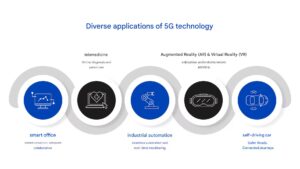
5G is already reshaping our digital world. By 2025, its ability to handle massive amounts of data traffic is expected to enable widespread adoption of disruptive technologies. These include self-driving vehicles, an extensive IoT ecosystem, seamless 4K/8K video streaming, and immersive AR/VR applications. Experts predict that by 2030, 5G will contribute more than $1.3 trillion to the global economy, driving innovation and redefining industries worldwide.
How 5G Works
5G combines advanced radio spectrum bands with cutting-edge technology to deliver incredible speeds, low latency, and high connection density. Here’s how it works:
● Sub-6 GHz and mmWave: 5G networks operate on a variety of radio frequencies. Sub-6 GHz bands (below 6 GHz) offer broad coverage, making them ideal for widespread deployment, especially in rural and suburban areas. Meanwhile, mmWave bands (24-40 GHz) offer the bandwidth for ultra-fast data transmission, making them ideal for densely populated urban centers and high-demand environments like stadiums and airports.
● Advanced Antenna Systems: 5G employs MIMO (Multiple Input, Multiple Output) antenna technology, allowing multiple data streams to be transmitted and received simultaneously. This technology significantly increases network capacity, allowing more devices to connect without sacrificing speed or reliability.
● Small Cell Networks: To ensure consistent performance, 5G leverages small cell networks. These are compact base stations installed on streetlights, rooftops, and utility poles, enhancing localized network capacity and providing seamless connectivity in densely populated areas.
● Orthogonal Frequency Division Multiple Access (OFDMA): This advanced modulation technique divides the spectrum into small subchannels, optimizing spectrum use. OFDMA allows multiple users to access the network simultaneously, enabling efficient data transmission even under heavy load.
● Network Slicing: One of 5G’s most innovative technologies, network slicing, enables the creation of multiple virtual networks on a shared physical infrastructure. Each slice can be optimized for a specific use case; for example, a network can be configured for ultra-low latency communications for self-driving cars or high-definition video streaming.
● Edge Computing: To minimize latency, 5G incorporates edge computing, which processes data closer to the user through localized data centers. This approach not only improves response times but also reduces the load on central servers, improving the overall efficiency of the network.
Inventor of 5G Technology
The development of 5G technology has been the result of extensive collaboration between telecommunications companies, academic institutions, and technology standards organizations around the world. No single company can claim to have “invented” 5G; its development has been shaped by the contributions of industry leaders such as Ericsson, Nokia, Qualcomm, Samsung, Huawei, and ZTE. Each of these companies has played a key role in innovating the hardware, software, and infrastructure that underpins 5G networks.
As key international organizations, 3GPP (Third Generation Partnership Project) and ITU (International Telecommunication Union) have played crucial roles in formulating the 5G technical standards. Notably, 3GPP published the first 5G specifications in 2018, paving the way for global commercial deployment.
TDK is focusing on evolving the core components that support 5G networks. Our innovations span a wide range, including ultra-compact DC-DC converters and LTCC AiP (Antenna in Package) devices, which are essential for optimizing small cell base stations—a key requirement for the high speeds and low latency of 5G. These technologies improve the efficiency and performance of 5G infrastructure, enabling seamless connectivity even in densely populated areas.
TDK will continue to actively engage in initiatives that push the boundaries of current trends, such as “Beyond 5G.” Our research focuses on next-generation wireless technologies, ensuring that 5G evolves to meet the demands of a hyper-connected future.
5G Speeds
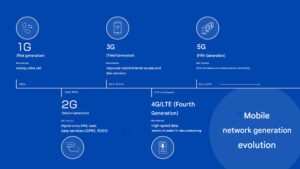
5G represents a quantum leap in mobile network technology, setting new standards for speed, reliability, and connectivity. To understand why 5G is a game-changer, let’s first look at the evolution of mobile networks.
● 1G (1980s): An analog system designed primarily for voice calls. With no encryption, security was virtually nonexistent and data speeds were negligible.
● 2G (1990s): The first digital network introduced enhanced security and basic data services like SMS. However, speeds were capped at just 64 kbps, making it take more than 20 minutes to download a three-minute song.
● 3G (2000s): Brought mobile internet mainstream with speeds ranging from 384 kbps to 2 Mbps. While an improvement, these speeds were insufficient for smooth video and music streaming.
● 4G LTE (2010s): A turning point, with speeds capable of supporting HD video streaming, advanced applications, and large file downloads. While theoretical peak speeds reached 100 Mbps, in practice, speeds were often slower.
The arrival of 5G has ushered in a new era. How much faster is 5G than 4G? 5G uses advanced radio frequency bands and short data transmission bursts to deliver ultra-high speeds and ultra-low latency. Latency has been reduced to just a few milliseconds, enabling real-time communication for devices like self-driving cars and smart home systems.
Speed Advantage:
5G surpasses 4G in every metric. Peak download speeds can reach up to 20Gbps, 20 times faster than 4G’s 1Gbps. For example, downloading a full HD movie takes just 3.6 seconds with 5G, compared to 26 hours with 3G and 6 minutes with 4G.
Why is 5G better than LTE or 4G?
5G benefits go beyond speed. It offers:
● Massively increased capacity, enabling millions of devices to connect seamlessly
● Reduced latency, essential for applications such as telemedicine and industrial automation
● Improved network reliability, paving the way for innovation in healthcare, manufacturing, transportation, and more
A Radical Upgrade:
5G is not a gradual improvement; it is a 10-100x upgrade over 4G networks. From speed to capacity to reliability, 5G represents a paradigm shift in what networks can achieve.
The Big Picture:
5G network capabilities will enable a world of seamless connectivity and real-time automation not possible with previous generations. 5G networks will not only deliver faster speeds, but also enable real-time data processing, connecting billions of devices and unlocking new possibilities like smart cities and autonomous technology. While past communications technologies connected people, 5G will connect the world.
The Next Step:
The foundation established by 5G paves the way for future advancements like 6G, which promises even faster speeds, lower latency, and unprecedented innovation.
Follow us on Facebook for updates and exclusive content! Click here: Maga AI