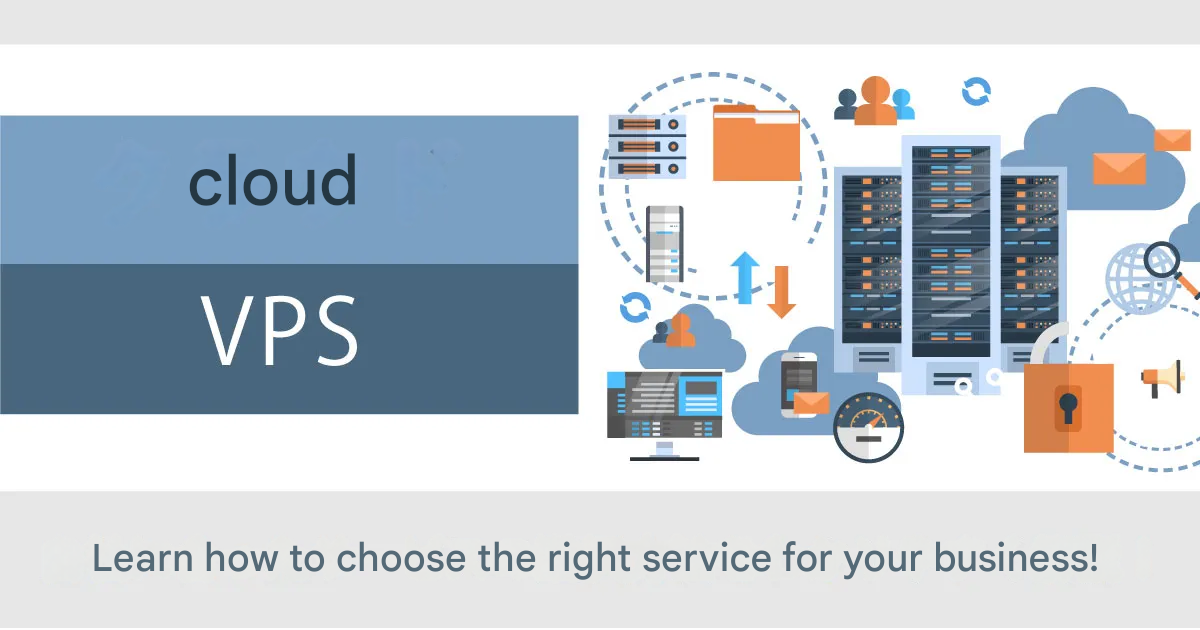
Do you know the difference between the cloud and VPS? Both utilize virtualization technology, but strictly speaking, they are different. So, what exactly are the differences?
In this article, we will explain the basics of the cloud and VPS, as well as the differences between them in an easy-to-understand way. We will also explain how to choose the right service for your company from the perspective of whether you should choose the cloud or VPS, so please read to the end.
What is the Cloud?
The cloud refers to a “virtual infrastructure on the internet.” Instead of storing data on devices like PCs or smartphones, storing and operating it in a virtual space (server) that exists on the internet is called “cloud computing.”
Generally, the cloud is classified into three categories: “SaaS,” “PaaS,” and “IaaS.”
| Type | Features | Service Examples |
|---|---|---|
| SaaS | Runs applications and software on the cloud | ・G Suite ・Office365 ・Online storage |
| PaaS | Provides application development environments on the cloud | ・Google App Engine ・Microsoft Azure |
| IaaS | Provides system infrastructure on the cloud | ・Google Compute Engine ・Amazon Elastic Compute Cloud |
Additionally, within the cloud, there are “public clouds” and “private clouds,” each with different characteristics. Please see the reference article below for details.
Features
High Customizability
Because the cloud allows you to freely use multiple servers, it offers higher customizability compared to VPS. This enables flexible operation according to your company’s objectives. However, please understand that the degree of freedom is lower compared to on-premises environments where you prepare all the equipment yourself.
Many Services Use a Pay-as-You-Go Model
Many cloud services adopt a pay-as-you-go pricing model. This is a system where the fee fluctuates based on resource usage; the more you use, the higher the cost. Therefore, when introducing cloud services, it is necessary to correctly understand the billing conditions and use them appropriately.
High Flexibility and Scalability
A major characteristic of the cloud is its high flexibility and scalability. Because a single contract allows you to use multiple virtual servers, you can increase or decrease resources according to your company’s situation, or operate by dividing virtual servers for different purposes. This ability to achieve flexible management that can respond to change is a significant advantage of the cloud.
Usage Scenarios
Main usage scenarios for the cloud include:
Cost savings by leveraging the pay-as-you-go model
Reducing costs for introducing servers and software
Improving operational efficiency by omitting maintenance
Starting small with the assumption of future resource expansion
Operating multiple servers according to purpose
Running websites with sudden traffic fluctuations
As you can see, the cloud has a wide variety of usage scenarios. If you are considering using virtual servers, please use this as a reference.
What is VPS?
Overview
VPS is an abbreviation for “Virtual Private Server.” Simply put, VPS is a service that builds independent virtual servers on a physical server, allowing you to use them as if they were dedicated servers just for your company.
A similar service to VPS is “shared hosting,” but the two are clearly different. With shared hosting, multiple users share one physical server, so there are restrictions on the OS and memory, and your usage may be affected by other users.
On the other hand, while VPS also involves multiple users sharing one physical server, it utilizes virtualization technology so you can use it as if a dedicated server for each user were built on the physical server. For example, in VPS, a guest OS for each user is prepared on top of the host OS of the physical server, and users do not interfere with each other.
Furthermore, because you can freely use applications, memory, etc., in your own environment, flexible operation tailored to the situation is possible. Thus, a major advantage of VPS is its higher degree of freedom compared to traditional shared hosting, and the absence of failures or slowdowns caused by other users.
However, because VPS is a service form that essentially uses only a single virtual server, its freedom and customizability are lower compared to the cloud, which allows the use of multiple virtual servers.
Features
Easy to Introduce and Operate
VPS uses a simple mechanism where one virtual server is allocated to one user. Therefore, it is relatively easy to introduce even without specialized IT knowledge. Additionally, because hardware resources dedicated to the user are allocated to the VPS virtual server, it is less susceptible to the influence of other users, which is another feature that helps reduce operational workload.
Many Services Use a Flat-Rate Model
While we explained that many cloud services use a pay-as-you-go model, most VPS services use a flat-rate model. The amount varies depending on the VPS provider and plan, but you pay a predetermined fee each month. Therefore, one characteristic of VPS compared to the cloud is that it is easier to plan budgets.
Resources are Predetermined
With VPS, the usable resources (CPU, memory, SSD, data capacity) are determined for each plan, similar to a physical server. Basically, you cannot change the contracted plan later, so it is important to choose the optimal service and plan based on your company’s purpose, usage, and budget for using VPS.
Usage Scenarios
Main usage scenarios for VPS include:
Operating with only one server
Cost optimization through monthly flat fees
Operating systems that do not require customization
Ensuring stability without being affected by other users
As you can see, the usage scenarios for VPS differ from those for the cloud. Understand the characteristics of each and choose the service that suits your company.

Differences Between Cloud and VPS
We have explained cloud and VPS separately up to this point, but what exactly are the differences?
This chapter explains the differences between the two in an easy-to-understand way.
Initial Cost
Regarding initial costs, there is no significant difference between cloud and VPS. Both are services that operate by renting a virtual server environment, so there is no need to prepare physical servers or network equipment, and in many cases, they can be used with no initial cost.
Pricing Structure
Many cloud services adopt a pay-as-you-go model where the cost increases with usage, while many VPS services adopt a flat-rate model where a fixed amount is paid monthly. Each pricing structure has its pros and cons, so it is important to choose the optimal service according to your company’s situation.
Number of Virtual Servers
The cloud allows the use of multiple virtual servers according to the purpose, but VPS only allows the use of one virtual server. For simple operation with a single server, VPS is sufficient, but if customization is needed, you should choose the cloud.
Scalability
The cloud is highly scalable, allowing you to freely increase or decrease resources as needed. On the other hand, VPS does not allow flexible resource changes, so if you need to reassess resources, you may have to cancel the service and sign a new contract.
Customizability
Because the cloud allows you to freely use multiple servers, its customizability is relatively high. On the other hand, VPS builds independent virtual servers on a single physical server, so customizability is lower. If you want to achieve flexible operation, the cloud is a recommended choice.
Summary
The following table summarizes the differences between cloud and VPS.
| Item | Cloud | VPS |
|---|---|---|
| Initial Cost | Often free | Often free |
| Pricing Structure | Often pay-as-you-go | Often monthly flat-rate |
| Number of Virtual Servers | Multiple servers can be used | Only one server can be used |
| Scalability | High | Low |
| Customizability | High | Low |
As you can see, there are various differences between cloud and VPS. They are services with different characteristics, so it is important to choose the optimal one according to your company’s situation.
How to Choose Between Cloud and VPS for Your Company
In the previous chapter, we detailed the differences between cloud and VPS. However, when it comes to actually choosing a service, some people may get confused and not know the criteria for judgment.
Therefore, in this chapter, we will explain how to choose the optimal service for your company from the perspective of “whether to choose cloud or VPS.”
As a basis for thinking, it’s easy to understand if you think of “the cloud as an evolved form of VPS.” First, judge whether VPS can meet your company’s requirements, and if it’s difficult, consider the cloud.
Cost
When introducing a new service, cost is an important point. To manage a business efficiently, it is necessary to minimize introduction costs and maximize cost performance.
As mentioned earlier, because the cloud is an evolved form of VPS, the cloud generally tends to be more expensive than VPS. If you have budget flexibility, you should consider the cloud, but if you want to keep costs as low as possible, choose VPS.
Intended Use
When your company considers cloud or VPS, it is important to clarify its intended use. Although the cloud tends to be more expensive than VPS, the cloud allows flexible customization and free expansion, so depending on your company’s requirements, using the cloud may be essential.
Cases where cloud usage is required include situations where multiple virtual servers are needed, or when operating with the assumption of resource expansion. First, calmly analyze your company’s situation and specify the necessary functions and requirements.
Then, based on that, decide whether to choose cloud or VPS, considering your budget. Additionally, since many cloud services use a pay-as-you-go model, to make running costs easier to manage, you should choose one with clear billing conditions.
Need for Customization
When choosing between cloud and VPS, the need for customization is a point you must check. This is because if you need individual customization tailored to your company’s situation, it is often difficult to achieve with VPS.
If no customization is needed and you are performing general system operation, VPS is sufficient. However, if you are operating with the assumption of customization, using the cloud is the recommended option. By clarifying your intended use and considering the need for customization in this way, you can make an appropriate decision.
Google Cloud (GCP) is Recommended for Cloud Use
Both the cloud and VPS are convenient services that utilize virtual servers, but using the cloud is recommended to survive in an era of rapid change. The cloud allows you to flexibly respond to unexpected changes, and it is possible to build a stable management foundation that allows you to continue your business calmly even if problems occur.
There are various cloud services on the market, but cost performance and operational efficiency vary greatly depending on which service you choose, so please select carefully.
For example, service reliability is a very important point. You don’t want to use a service that might be discontinued at any time, right? Also, because the cloud is a pay-as-you-go service, choose one with easy-to-understand billing conditions. Otherwise, there is a risk of unexpectedly high charges.
Additionally, you need to consider factors such as ensuring security to prevent information accidents and data processing speed to improve productivity. Taking these various elements into account, it is important to choose the cloud service that best suits your company.
And one service that meets all these elements at a high level is “Google Cloud (GCP),” a public cloud service provided by Google. Google Cloud (GCP) is also used as the infrastructure for operating Google’s services such as Gmail, YouTube, and Google Maps, and its major characteristic is its proven track record of service operation.
Here are some reasons why Google Cloud (GCP) is recommended for cloud use:
Google’s Growth Potential
Google’s technology, which is at the forefront of the world, evolves daily. Because Google Cloud (GCP) is a cloud service provided by Google, the service itself continues to grow along with Google’s evolution.
New features are added and usability is improved in short cycles, allowing companies to always leverage the latest technology for their management. This ability to freely utilize Google’s infrastructure is a major reason for Google Cloud (GCP)’s popularity.
Easy Cost Management
Google Cloud (GCP) is a service provided 100% in the cloud, so there are no initial costs. The monthly fee is “pay-as-you-go,” meaning you pay only for what you use, not a fixed amount each month.
Therefore, there is no worry about incurring unnecessary costs, and you can use the service according to your company’s situation. Furthermore, Google Cloud (GCP)’s billing system is designed to be simple and easy to understand, and you can check your bill amount anytime from the management console.
Thus, in addition to the functional advantage of being able to use Google’s infrastructure, the ease of managing incurred costs is another attraction of Google Cloud (GCP).
High Security Level
Google Cloud (GCP) has a high level of security with third-party certifications, undergoing many annual audits such as “SSAE 16 / ISAE 3402 Type II: SOC 2/ SOC 3,” “ISO 27001 / FISMA Moderate,” and “PCI DSS v3.0,” so you can use it for actual business with confidence.
Because Google Cloud (GCP) is a highly robust service, it is increasingly used not only as a primary environment but also as a sub-environment for hybrid clouds. By using Google Cloud (GCP) to create redundancy, you can achieve more secure cloud operation.
Fast Data Processing Speed
Google services are famous for their fast data processing speed. For example, with the big data analysis service “BigQuery” built into Google Cloud (GCP), queries that usually take a long time can be completed in seconds or tens of seconds for data volumes of several terabytes or petabytes. Data processing speed is an important point directly linked to work productivity, and this is one reason why Google Cloud (GCP) is chosen.
The following article is helpful regarding BigQuery.
Conclusion
In this article, we have explained the basics and differences between the cloud and VPS in an easy-to-understand manner. We hope you now understand the characteristics of each and how to choose a service that fits your company.
Recently, the importance of virtualization technology is increasing due to changes in the social environment and increases in data volume. While both the cloud and VPS utilize virtual servers, they actually have many differences in terms of pricing structure, scalability, and customizability.
Both are convenient services, but using the cloud is recommended to survive in an era of rapid change. The cloud allows you to flexibly respond to unexpected changes, and it is possible to build a stable management foundation that allows you to continue your business calmly even if problems occur.
There are numerous cloud services on the market, but if you are considering introduction, please consider Google Cloud (GCP) as an option. By utilizing Google Cloud (GCP), companies can enjoy many benefits, including a high security level and high-speed data processing.
Follow us on Facebook for updates and exclusive content! Click here: Maga AI